

Chakki Atta vs Maida: Which Flour Is Better for Your Health?
Atta vs Maida: Which Is Better for Health? Complete Guide to Chakki Atta, Nutrition & Benefits
Choosing the right flour is one of the simplest ways to improve your daily diet. In India, wheat flour is a staple ingredient used to prepare rotis, chapatis, parathas, pooris, breads, and many other traditional foods. However, many people are confused about the difference between Atta and Maida, and often search questions like “Is Atta healthier than Maida?”, “What is Chakki Atta?”, or “Which flour is better for daily use?”
Although both Atta and Maida are made from wheat, they are processed differently, resulting in significant differences in nutrition, fibre content, texture, taste, and health benefits. Understanding these differences helps you make informed food choices for yourself and your family.
In this comprehensive guide, you’ll learn everything about Atta, Chakki Atta, Whole Wheat Flour, and Maida, including their nutritional value, health benefits, processing methods, calories, everyday uses, and how to select high-quality wheat flour for your kitchen.
Quick Answer: Is Atta Better Than Maida?
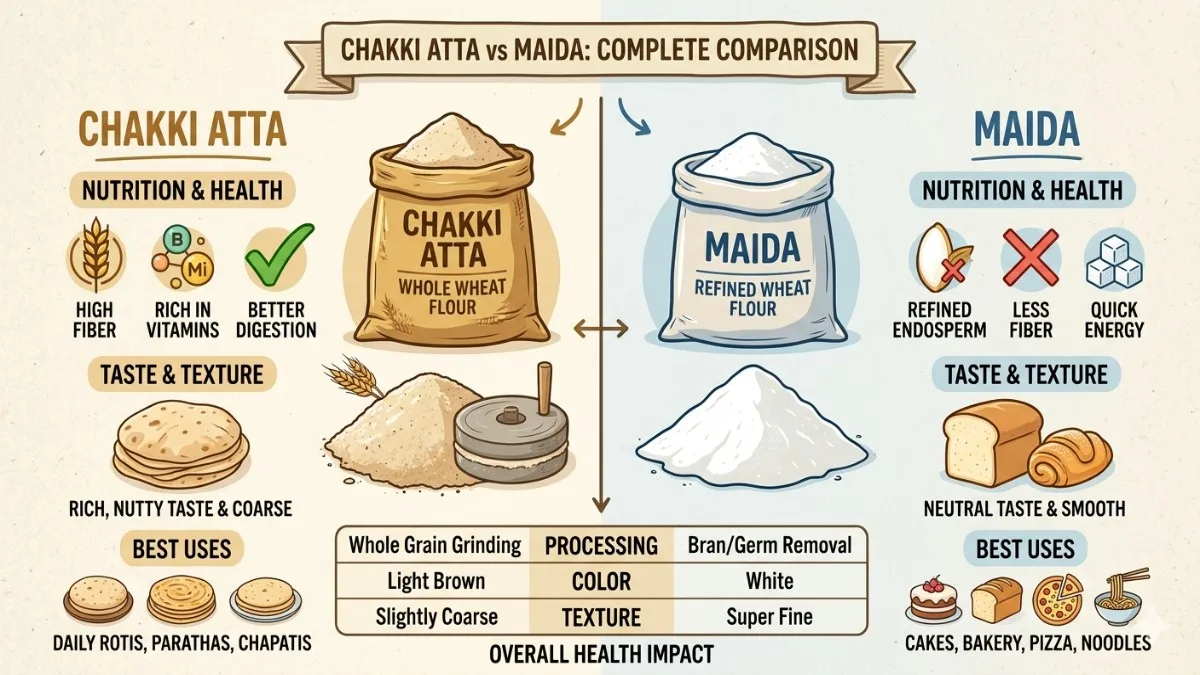
Yes, whole wheat Atta is generally considered healthier than Maida for everyday consumption. Whole wheat Atta contains all three parts of the wheat grain—bran, germ, and endosperm—making it naturally richer in dietary fibre, vitamins, minerals, and plant compounds. In contrast, Maida is a refined wheat flour produced by removing the bran and germ, leaving mainly the starchy endosperm.
While both flours provide carbohydrates and energy, whole wheat Atta offers better nutritional value, supports digestive health, and provides greater satiety due to its higher fibre content. Maida remains suitable for products such as cakes, pastries, breads, biscuits, pizza bases, and other baked foods where a softer texture is preferred.
| Quick Comparison | Winner |
|---|---|
| Daily Household Use | ✅ Whole Wheat Atta |
| Higher Dietary Fibre | ✅ Whole Wheat Atta |
| Better Nutrient Retention | ✅ Whole Wheat Atta |
| Soft Cakes & Pastries | ✅ Maida |
| Chapati & Roti | ✅ Chakki Atta |
| Overall Nutrition | ✅ Whole Wheat Atta |
What Is Atta?
Atta is the Hindi word commonly used for wheat flour. In India, the term usually refers to whole wheat flour, which is prepared by grinding the complete wheat grain. Unlike refined flour, whole wheat Atta retains the natural bran, germ, and endosperm, preserving much of the grain’s original nutritional composition.
Atta has been a fundamental part of Indian households for generations and is widely used to prepare:
- Chapati
- Roti
- Phulka
- Paratha
- Poori
- Thepla
- Missi Roti
- Traditional Indian breads
The nutritional quality of Atta largely depends on the wheat variety, milling process, storage conditions, and manufacturing practices. Freshly milled whole wheat flour generally retains more of the grain’s natural characteristics than heavily refined flour.
Did You Know?
Whole wheat Atta contains the complete wheat kernel, making it one of the most commonly consumed staple foods across Indian households.
What Is Chakki Atta?
Chakki Atta is whole wheat flour produced by grinding wheat grains using a traditional stone mill (known as a chakki) or a modern milling system designed to replicate the traditional grinding process.
The word “Chakki” simply means a grinding mill. Traditionally, stone mills rotate slowly, grinding wheat into flour while retaining the complete wheat kernel. Modern food manufacturers also use advanced milling technologies that aim to maintain flour quality while achieving consistent production.
Unlike refined flour, Chakki Atta contains all three essential parts of the wheat grain:
- Bran – Rich in dietary fibre.
- Germ – Contains natural oils, vitamins, minerals and antioxidants.
- Endosperm – Supplies carbohydrates and protein.
Because the entire grain is used, Chakki Atta naturally contains more fibre and micronutrients than refined wheat flour.
| Parts of Wheat Grain | Present in Chakki Atta? |
|---|---|
| Bran | ✅ Yes |
| Germ | ✅ Yes |
| Endosperm | ✅ Yes |
Chakki Atta Meaning
Many people search online for “Chakki Atta means” or “What is Chakki Atta?” The answer is straightforward.
Chakki Atta means flour produced by grinding whole wheat grains using a stone grinding process or an equivalent milling system that retains the complete wheat kernel.
The term does not represent a specific wheat variety. Instead, it refers to the milling method used to produce whole wheat flour.
Today, several trusted food manufacturers produce high-quality Chakki Atta by carefully selecting wheat varieties and maintaining strict quality standards throughout the milling and packaging process.
Is Chakki Atta the Same as Whole Wheat Flour?
In most cases, yes.
Both Chakki Atta and Whole Wheat Flour are made from the complete wheat grain and retain the bran, germ, and endosperm. However, the terminology can vary depending on the country, manufacturer, and milling process.
| Term | Meaning |
|---|---|
| Whole Wheat Flour | Flour made from the complete wheat grain. |
| Chakki Atta | Whole wheat flour traditionally produced using stone milling or equivalent milling methods. |
When purchasing packaged flour, always read the product label carefully to understand the ingredients, nutritional information, and manufacturing details.
What Is Maida?
Maida, also known as refined wheat flour, is produced by processing wheat grains to remove the bran and germ. Only the starchy endosperm is finely milled into a smooth white flour.
This refining process creates a softer texture, lighter colour, and improved baking performance, making Maida suitable for preparing products such as:
- White bread
- Cakes
- Cookies
- Pastries
- Pizza bases
- Naan
- Bakery products
- Biscuits
- Confectionery items
Although Maida offers excellent baking properties, removing the bran and germ also reduces much of the wheat grain’s naturally occurring fibre and several nutrients.
Important: Maida is not inherently “bad.” It simply serves a different culinary purpose than whole wheat Atta. For balanced nutrition, many people choose whole wheat Atta for everyday meals while using Maida occasionally for specific recipes.
How Are Atta and Maida Made?
Understanding how each flour is produced helps explain why their nutritional value differs.
How Whole Wheat Atta Is Made
- Carefully selected wheat grains are cleaned to remove dust, stones, and impurities.
- The grains are conditioned for milling.
- The complete wheat kernel is ground into flour.
- The bran, germ, and endosperm remain together.
- The flour is sieved, quality checked, and hygienically packed.
How Maida Is Made
- Wheat grains are cleaned.
- The bran and germ are separated from the grain.
- Only the endosperm is finely milled.
- The flour is repeatedly refined for a smoother texture.
- The finished flour is packed for commercial and household use.
This difference in processing is the primary reason why whole wheat Atta contains more dietary fibre and retains more naturally occurring nutrients than refined Maida.
What’s Next?
Now that you understand what Atta, Chakki Atta, Whole Wheat Flour, and Maida are, the next part of this guide explores their nutritional value, calories, health benefits, and a detailed side-by-side comparison to help you choose the right flour for your daily diet.
Atta vs Maida Nutrition: Which Flour Is More Nutritious?
One of the most frequently searched questions is “Maida vs Atta nutrition” or “Is Atta healthier than Maida?” The answer lies in how each flour is processed.
Whole wheat Atta retains the complete wheat kernel, including the bran, germ, and endosperm. These parts naturally provide dietary fibre, protein, vitamins, minerals, and beneficial plant compounds. Maida, on the other hand, is produced by removing the bran and germ, leaving mainly the starchy endosperm.
Although both flours provide carbohydrates and energy, their nutritional quality differs considerably. Whole wheat Atta generally offers more fibre and micronutrients, making it a preferred choice for everyday meals.
Maida vs Atta Nutritional Value Per 100g
The following values are approximate and may vary depending on wheat variety, milling process, moisture content, and manufacturer.
| Nutrient (Approx. per 100g) | Whole Wheat Atta | Maida |
|---|---|---|
| Energy | 340 kcal | 364 kcal |
| Protein | 12 g | 10.3 g |
| Carbohydrates | 72 g | 76 g |
| Dietary Fibre | 10–12 g | 2–3 g |
| Total Fat | 2 g | 1 g |
| Iron | Higher | Lower |
| Magnesium | Higher | Lower |
| B Vitamins | Naturally Higher | Reduced During Refining |
| Zinc | Higher | Lower |
Key Takeaway: Whole wheat Atta contains significantly more dietary fibre and naturally occurring nutrients than refined Maida, even though both provide similar calories.
Maida vs Atta Calories: Which Has More Calories?
Many people assume that whole wheat Atta contains much fewer calories than Maida. In reality, the calorie difference is relatively small.
| Flour | Calories per 100g (Approx.) |
|---|---|
| Whole Wheat Atta | 340 kcal |
| Maida | 364 kcal |
The primary nutritional advantage of Atta is not significantly lower calories but its higher fibre content. Fibre promotes fullness, supports digestive health, and slows the digestion of carbohydrates, making whole wheat Atta a more balanced option for daily meals.
Quick Fact:
Calories alone do not determine whether a food is healthy. Fibre, protein, vitamins, minerals, and overall dietary quality are equally important.
Atta vs Maida Health Benefits
Choosing the right flour depends on how you use it, but for everyday Indian meals, whole wheat Atta is generally preferred because it retains the complete grain.
| Health Factor | Whole Wheat Atta | Maida |
|---|---|---|
| Dietary Fibre | ★★★★★ | ★☆☆☆☆ |
| Natural Vitamins | ★★★★★ | ★★☆☆☆ |
| Minerals | ★★★★★ | ★★☆☆☆ |
| Digestive Support | ★★★★★ | ★★☆☆☆ |
| Suitable for Daily Rotis | ★★★★★ | ★☆☆☆☆ |
| Ideal for Cakes & Pastries | ★★☆☆☆ | ★★★★★ |
| Natural Wheat Flavour | ★★★★★ | ★★☆☆☆ |
Is Atta Healthier Than Maida?
Yes. For most people, whole wheat Atta is considered a healthier option than Maida because it retains all parts of the wheat grain.
Whole wheat Atta naturally provides:
- Higher dietary fibre
- Better nutrient retention
- Natural wheat flavour
- Greater satiety after meals
- A wholesome nutritional profile
Maida, however, remains useful for recipes that require a lighter texture, such as cakes, pastries, biscuits, pizza dough, naan, and bakery products.
Which Is Better for Weight Loss: Atta or Maida?
Many people searching for healthier eating habits ask whether Atta or Maida is better for weight management.
Although both contain similar calories, whole wheat Atta contains much more dietary fibre. Foods prepared with fibre-rich flour tend to keep people feeling satisfied for longer, which may help reduce unnecessary snacking as part of an overall balanced diet and healthy lifestyle.
Maintaining a healthy weight depends on total calorie intake, physical activity, sleep, and overall eating patterns rather than a single ingredient.
Which Flour Is Better for People Managing Blood Sugar?
Whole wheat Atta is commonly preferred over refined Maida because the bran and fibre naturally present in whole wheat slow digestion compared to refined flour.
However, individuals living with diabetes or other medical conditions should always follow advice provided by their doctor or registered dietitian when selecting foods appropriate for their health needs.
Health Note:No single food can prevent or cure diabetes. A balanced diet, portion control, regular exercise, and medical guidance remain essential.
Which Flour Is Better for Heart Health?
Whole grains are widely recognised as an important component of a balanced diet. Whole wheat Atta retains the fibre naturally found in wheat, while refined Maida contains considerably less.
Many dietary guidelines encourage choosing whole grains more often as part of an overall healthy eating pattern.
Expert Summary
| If Your Goal Is… | Recommended Flour |
|---|---|
| Daily Chapati & Roti | ✅ Whole Wheat Atta |
| Higher Fibre Intake | ✅ Whole Wheat Atta |
| Traditional Indian Meals | ✅ Chakki Atta |
| Cakes & Pastries | ✅ Maida |
| Pizza & Bakery Products | ✅ Maida |
| Balanced Everyday Nutrition | ✅ Whole Wheat Atta |
For households seeking fresh, high-quality whole wheat flour, choosing a trusted manufacturer that focuses on quality wheat selection, hygienic processing, and proper packaging is just as important as selecting the right type of flour. Brands such as Kathait Gold™ and Hilvera™ are committed to delivering carefully processed wheat flour designed for everyday family meals.
Difference Between Chakki Atta and Whole Wheat Flour
One of the most common questions consumers ask is “What is the difference between Chakki Atta and Whole Wheat Flour?” The answer is that, in most cases, there is little or no nutritional difference. Both are generally produced from the complete wheat grain and contain the bran, germ, and endosperm.
The primary difference usually lies in the milling method, the brand’s manufacturing process, and the quality of wheat used.
| Feature | Chakki Atta | Whole Wheat Flour |
|---|---|---|
| Made From | Whole Wheat Grain | Whole Wheat Grain |
| Bran | Present | Present |
| Germ | Present | Present |
| Endosperm | Present | Present |
| Traditional Stone Milling | Usually Yes | May or May Not |
| Nutrition | Comparable | Comparable |
In India, the term Chakki Atta often highlights the milling process, whereas Whole Wheat Flour is a broader product description. Consumers should focus on ingredient quality, manufacturing standards, and freshness rather than the name alone.
What Is Chakki Atta vs Normal Atta?
The phrase “Normal Atta” can have different meanings depending on the manufacturer. Some brands use it to describe conventionally milled wheat flour, while others use it as a general term for packaged Atta.
When comparing Chakki Atta with normal packaged Atta, consider the following factors:
- Quality of wheat used.
- Milling technology.
- Freshness of flour.
- Presence of the complete wheat kernel.
- Quality control during manufacturing.
- Hygienic packaging.
A high-quality Chakki Atta is generally produced using carefully selected wheat grains while preserving the natural goodness of the whole grain.
Top Benefits of Chakki Atta
Whole wheat Chakki Atta remains one of the most popular flour choices in Indian households because of its nutritional profile and versatility.
1. Naturally Rich in Dietary Fibre
The bran layer provides dietary fibre, which supports digestive health and contributes to a feeling of fullness after meals.
2. Retains the Complete Wheat Grain
Since Chakki Atta contains the bran, germ, and endosperm, it preserves much of the wheat grain’s naturally occurring nutrients.
3. Ideal for Everyday Indian Meals
Chakki Atta is commonly used for chapatis, rotis, parathas, pooris, and other traditional Indian flatbreads.
4. Natural Wheat Aroma
Freshly milled whole wheat flour offers a pleasant wheat aroma and authentic taste that many households prefer.
5. Excellent Dough Quality
Whole wheat Atta produces soft, pliable dough suitable for preparing a variety of Indian breads.
6. Versatile Kitchen Ingredient
Besides rotis, Chakki Atta can be used to prepare stuffed parathas, theplas, puris, pancakes, baked snacks, and many regional recipes.
Best Uses of Atta and Maida
| Food Item | Best Flour |
|---|---|
| Chapati | ✅ Chakki Atta |
| Roti | ✅ Chakki Atta |
| Paratha | ✅ Chakki Atta |
| Poori | ✅ Whole Wheat Atta |
| Cakes | ✅ Maida |
| Cookies | ✅ Maida |
| Pizza Base | ✅ Maida |
| White Bread | ✅ Maida |
| Naan | ✅ Maida |
| Bakery Products | ✅ Maida |
Which Is Cheaper: Atta or Maida?
The price of Atta and Maida depends on several factors, including wheat quality, processing methods, brand reputation, packaging, transportation, and regional market conditions.
In many markets, refined Maida may be slightly less expensive because it is manufactured for large-scale commercial use. However, premium-quality whole wheat Atta made from carefully selected wheat varieties may cost more due to higher raw material quality and processing standards.
Instead of choosing flour based solely on price, consider:
- Freshness
- Ingredient quality
- Food safety standards
- Brand reliability
- Manufacturing practices
- Packaging quality
How to Choose the Best Quality Atta
Selecting the right flour is important for both taste and nutrition. Before purchasing, check the following:
- Read the ingredient list carefully.
- Look for whole wheat as the primary ingredient.
- Check the manufacturing and packaging date.
- Ensure the package is properly sealed.
- Verify the FSSAI licence information.
- Purchase from a trusted manufacturer.
- Choose the pack size according to your household consumption.
- Store the flour correctly after opening.
Brands that prioritise quality wheat selection, hygienic manufacturing, and careful packaging—such as Kathait Gold™ and Hilvera™—help consumers enjoy fresh, wholesome flour for everyday cooking.
How to Store Atta Properly
Proper storage helps preserve the freshness, aroma, and quality of whole wheat flour.
- Store in a clean, dry, airtight container.
- Keep away from direct sunlight.
- Avoid exposure to moisture.
- Use a clean, dry scoop every time.
- Close the container immediately after use.
- Follow the manufacturer’s best-before guidance.
- Purchase quantities that match your household’s regular consumption.
Storage Tip:
Whole wheat flour contains the wheat germ, which includes natural oils. Proper storage helps maintain freshness and quality for longer.
Common Myths About Atta and Maida
Myth 1: Atta Has No Calories
Fact: Whole wheat Atta contains calories, just like Maida. The difference lies in fibre and overall nutritional composition.
Myth 2: All Atta Is the Same
Fact: Wheat variety, milling process, and quality control can influence flour quality, taste, and texture.
Myth 3: Maida Is Poison
Fact: Maida is a refined wheat flour used widely in baking and food preparation. While it contains less fibre than whole wheat Atta, it can still be part of a balanced diet when consumed in appropriate quantities.
Myth 4: Expensive Atta Is Always Better
Fact: Price alone does not determine quality. Always evaluate ingredient quality, manufacturing standards, freshness, packaging, and brand credibility.
Myth 5: Stone-Ground Flour Never Changes
Fact: Milling technology has evolved. Modern food manufacturers may use advanced systems designed to deliver consistent quality while preserving the characteristics expected of whole wheat flour.
Consumer Checklist Before Buying Wheat Flour
| Checklist | Verify |
|---|---|
| Whole Wheat Ingredients | ✅ |
| Fresh Manufacturing Date | ✅ |
| Proper Packaging | ✅ |
| FSSAI Compliance | ✅ |
| Trusted Manufacturer | ✅ |
| Suitable Pack Size | ✅ |
| Storage Instructions | ✅ |
Choosing a quality whole wheat Atta is about more than just comparing prices. Freshness, hygienic manufacturing, reliable sourcing, and proper storage all contribute to the overall quality of the flour you use every day.
Frequently Asked Questions (FAQs)
1. Is Atta healthier than Maida?
Yes. Whole wheat Atta is generally considered healthier for everyday consumption because it contains the bran, germ, and endosperm of the wheat grain. This provides more dietary fibre and naturally occurring nutrients than refined Maida.
2. Which is better for health: Atta or Maida?
For daily Indian meals, whole wheat Atta is generally the preferred choice because it retains the complete wheat grain. Maida is better suited for bakery products such as cakes, pastries, cookies, pizza bases, and breads.
3. What is Chakki Atta?
Chakki Atta is whole wheat flour prepared by grinding the complete wheat grain using a traditional stone mill (chakki) or an equivalent modern milling system. It retains the bran, germ, and endosperm.
4. What does Chakki Atta mean?
The word “Chakki” refers to the grinding mill used to produce whole wheat flour. Chakki Atta simply means flour produced through a traditional stone-grinding process or an equivalent milling method.
5. Is Chakki Atta the same as Whole Wheat Flour?
In most cases, yes. Both are made from the complete wheat grain. The difference is generally related to the milling process or product terminology rather than nutritional composition.
6. What is the difference between Chakki Atta and Normal Atta?
Normal Atta is a general market term, while Chakki Atta specifically highlights the milling process. Product quality depends on wheat selection, manufacturing standards, and freshness.
7. What is the nutritional difference between Atta and Maida?
Whole wheat Atta contains more dietary fibre, vitamins, minerals, and natural plant compounds because it retains the complete grain. Maida contains mainly the refined endosperm.
8. Does Atta contain fewer calories than Maida?
No. The calorie difference is relatively small. The primary nutritional advantage of Atta is its higher fibre content rather than significantly lower calories.
9. Which flour is better for making chapati?
Whole wheat Chakki Atta is traditionally preferred for preparing soft chapatis, rotis, and parathas because of its natural wheat flavour and dough characteristics.
10. Can Maida be used for making rotis?
Yes, but it is generally not preferred for everyday rotis. Maida produces a softer dough that behaves differently from whole wheat flour and is more commonly used for bakery applications.
11. Which flour is better for baking?
Maida is commonly preferred for cakes, pastries, cookies, pizza dough, and many bakery products because its refined texture creates lighter baked goods.
12. Which flour contains more fibre?
Whole wheat Atta contains considerably more dietary fibre because it retains the bran layer of the wheat grain.
13. Is Whole Wheat Atta suitable for everyday use?
Yes. Whole wheat Atta is widely used across Indian households for preparing daily meals including chapatis, rotis, parathas, and pooris.
14. How should Atta be stored?
Store Atta in an airtight container in a cool, dry place away from moisture, heat, and direct sunlight. Always use a clean, dry spoon when handling flour.
15. How can I identify good quality Atta?
Choose products made from quality wheat, packed hygienically, carrying a valid FSSAI licence, and manufactured by trusted food brands. Always check the manufacturing and best-before dates before purchasing.
Conclusion
Although both Atta and Maida originate from wheat, they are designed for different purposes. Whole wheat Atta retains the complete grain—including the bran, germ, and endosperm—providing higher dietary fibre and a richer nutritional profile. Maida, produced by refining the wheat grain, offers a finer texture that makes it suitable for bakery and confectionery products.
For everyday Indian cooking, many families choose whole wheat Atta for preparing chapatis, rotis, and parathas because of its wholesome composition and traditional wheat flavour. Selecting flour from a trusted manufacturer, checking freshness, and storing it correctly can further help maintain quality and taste.
If you are looking for carefully processed whole wheat flour made with attention to quality, hygiene, and consistency, Kathait Gold™ and Hilvera™ offer dependable choices for modern Indian households.