

Yellow Mustard Oil vs Black Mustard Oil: The Complete & Best Comparison
Mustard seeds come in three main commercial varieties: yellow, brown, and black. Yellow mustard is mild and used primarily for condiments. Brown and black mustard offer higher pungency and oil yield, with brown mustard serving as the primary source for traditional Indian edible oil produced via cold pressing or Kachi Ghani.
Chemically, mustard oil is high in unsaturated fats and naturally contains essential omega-3 and omega-6 fatty acids. Widely used in regional Indian cooking, pickling, and tempering, high-quality mustard oil selection depends on seed variety, processing standards, proper packaging, and proper storage conditions to preserve natural aroma and flavor.
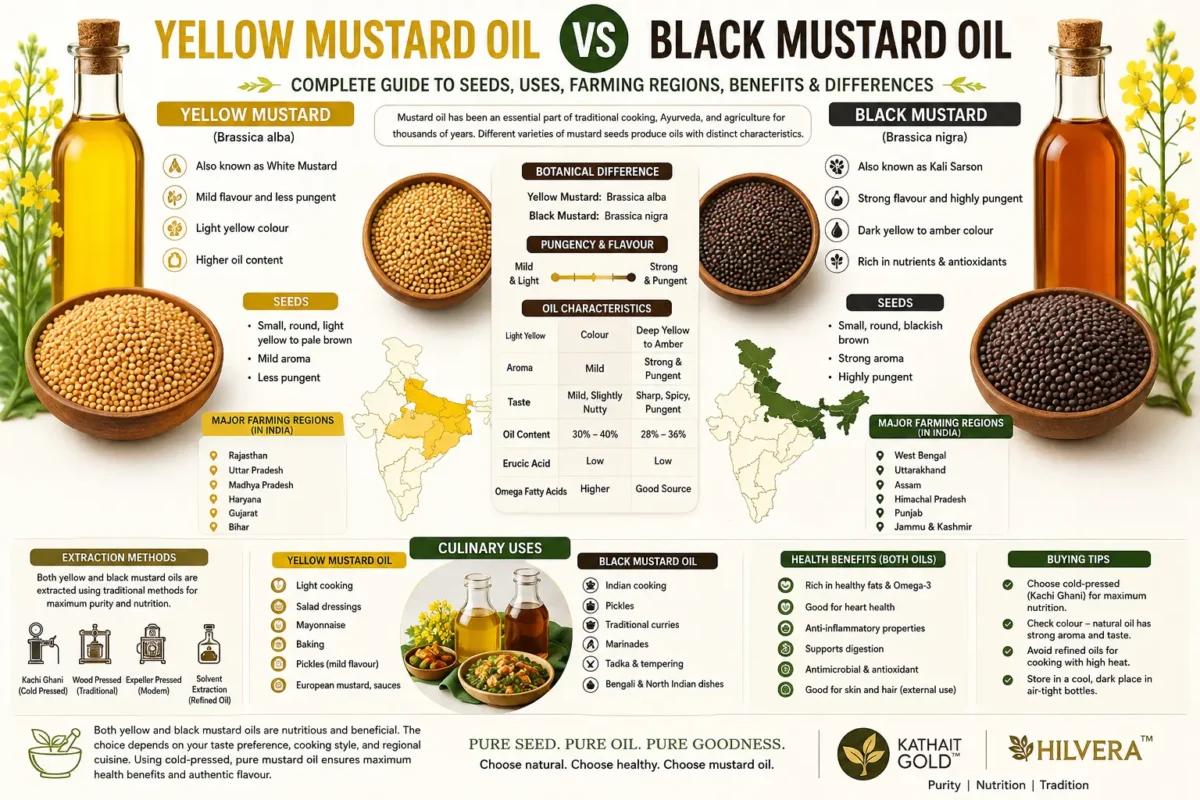
Yellow Mustard Oil vs Black Mustard Oil: Complete Guide to Seeds, Uses, Farming Regions, Benefits & Differences
Mustard oil has been an essential part of traditional cooking, Ayurveda, and agriculture for thousands of years. From the rich kitchens of India to the prepared mustard sauces of Europe and North America, mustard seeds have played a significant role in food culture across the world. Although many consumers purchase mustard oil regularly, very few understand that different varieties of mustard seeds produce oils with distinct characteristics.
Among the most common varieties are Yellow Mustard, Black Mustard, and Brown (Indian) Mustard. Each variety differs in botanical origin, flavour, pungency, oil content, cultivation regions, and culinary applications. Understanding these differences helps consumers choose the right mustard oil for their cooking style, nutritional preferences, and regional cuisine.
This comprehensive guide explains everything you need to know about yellow mustard oil and black mustard oil, including their botanical classification, farming regions, nutritional profile, extraction methods, cooking uses, health benefits, and buying tips.
What Is Mustard?
Mustard is a flowering plant belonging to the Brassicaceae family, commonly known as the cabbage or crucifer family. This botanical family also includes cabbage, broccoli, cauliflower, radish, kale, and turnip. Mustard plants are cultivated primarily for their seeds, which are used for producing edible oil, whole spices, powdered spices, condiments, and traditional medicines.
Mustard is considered one of the oldest cultivated oilseed crops in human history. Archaeological evidence suggests that mustard seeds were being used over 5,000 years ago in Asia and Europe. Ancient civilizations valued mustard not only as a spice but also as a medicinal herb because of its warming properties and distinctive aroma.
Today, mustard is grown in more than 70 countries and serves multiple industries including food processing, edible oils, pharmaceuticals, cosmetics, agriculture, and animal feed.
History of Mustard Cultivation
The cultivation of mustard dates back several millennia. Historical records indicate that mustard was widely grown in ancient India, China, Egypt, Greece, and the Roman Empire. Ancient Indian texts mention mustard as an important agricultural crop and medicinal ingredient, while Roman cooks prepared mustard pastes using crushed seeds mixed with grape juice, a preparation that eventually evolved into modern mustard condiments.
Over centuries, different species of mustard adapted to varying climates, resulting in the cultivation of black mustard, brown mustard, and yellow mustard across different geographical regions. Today, India remains one of the world’s largest producers and consumers of mustard seeds and mustard oil.
Botanical Classification
| Scientific Classification | Details |
|---|---|
| Kingdom | Plantae |
| Order | Brassicales |
| Family | Brassicaceae |
| Common Name | Mustard |
| Plant Type | Annual Oilseed Crop |
Although mustard plants appear similar during cultivation, their seeds differ significantly in colour, size, pungency, and oil content. These differences ultimately influence the flavour and characteristics of the oil extracted from them.
Major Types of Mustard Plants
Commercial mustard cultivation primarily involves three species. Each species has unique agricultural and culinary characteristics.
| Common Name | Botanical Name | Seed Colour | Primary Use |
|---|---|---|---|
| Black Mustard | Brassica nigra | Dark Brown to Black | Traditional Indian cooking, spices and premium mustard oil |
| Brown (Indian) Mustard | Brassica juncea | Brown | Most commonly cultivated mustard in India for edible oil |
| Yellow / White Mustard | Sinapis alba (also known as Brassica hirta) | Pale Yellow | Prepared mustard, sauces and mild-flavoured condiments |
Understanding the Difference Between Yellow, Brown and Black Mustard
One of the most common misconceptions is that all mustard oils are identical. In reality, the characteristics of mustard oil depend largely on the seed variety used during extraction.
- Yellow Mustard produces a milder flavour and is widely used for condiments and salad dressings.
- Brown Mustard, also known as Indian mustard, is the dominant oilseed variety cultivated across India and is commonly used for producing edible mustard oil.
- Black Mustard is highly aromatic and valued for its strong pungency, making it popular in traditional Indian cooking and premium cold-pressed mustard oils.
Although commercial mustard oils may contain seeds from one or more varieties depending on regional availability and manufacturing practices, the seed selection significantly influences flavour, aroma, colour, and pungency.
How Mustard Plants Grow
Mustard is a cool-season annual crop that generally matures within 90 to 130 days depending on the variety, climatic conditions, and agricultural practices. The plants typically grow between 1 and 2 metres in height and produce clusters of bright yellow flowers before forming slender seed pods known as siliques.
Each pod contains numerous small round seeds that vary in colour from pale yellow to dark brown or nearly black depending on the species. After maturity, the crop is harvested, dried, and processed to separate the seeds for oil extraction or spice production.
Structure of a Mustard Seed
Although mustard seeds are tiny, they contain several important components that contribute to oil quality and nutritional value.
| Seed Component | Function |
|---|---|
| Seed Coat | Protects the inner seed from environmental damage. |
| Cotyledons | Contain proteins, carbohydrates and natural oils. |
| Embryo | Develops into a new plant during germination. |
| Oil Cells | Store edible vegetable oil used for cold pressing. |
The proportion of natural oil stored within these cells varies among mustard species. Brown and black mustard generally contain higher oil percentages compared to yellow mustard, making them more suitable for commercial edible oil production.
Why Seed Variety Matters
The quality of mustard oil begins with the seed itself. Factors such as genetics, soil type, rainfall, temperature, harvesting methods, and oil extraction techniques all influence the final product.
For example, premium mustard seeds cultivated in suitable agro-climatic conditions often produce oil with a stronger aroma, higher oil recovery, and richer flavour profile. Similarly, cold-pressed extraction methods help retain many naturally occurring compounds that contribute to the oil’s traditional taste and aroma.
Did You Know?
India is one of the largest producers of mustard seeds in the world, with Rajasthan contributing a significant share of national production. Mustard cultivation also plays an important role in the livelihoods of millions of farmers across northern and central India.
What’s Coming Next
In the next part of this guide, we will explore Yellow Mustard Seeds, Black Mustard Seeds, and Brown (Indian) Mustard in much greater detail. We will compare their physical appearance, oil content, flavour, pungency, culinary applications, and commercial importance with detailed tables and expert insights.
Yellow Mustard Seeds vs Black Mustard Seeds vs Brown Mustard Seeds
Although mustard seeds may appear similar at first glance, each variety possesses unique botanical, agricultural, culinary, and nutritional characteristics. Understanding these differences is essential for consumers, chefs, food manufacturers, and anyone interested in selecting the most suitable mustard oil for cooking or commercial use.
Globally, three principal mustard species are cultivated commercially. These include Yellow Mustard, Black Mustard, and Brown (Indian) Mustard. While all belong to the Brassicaceae family, their seed colour, size, flavour, oil content, pungency, and growing conditions differ considerably.
Overview of the Three Major Mustard Species
| Characteristic | Yellow Mustard | Brown Mustard | Black Mustard |
|---|---|---|---|
| Botanical Name | Sinapis alba | Brassica juncea | Brassica nigra |
| Common Name | White Mustard | Indian Mustard | Black Mustard |
| Seed Colour | Pale Yellow | Brown | Dark Brown to Black |
| Average Seed Size | Largest | Medium | Smallest |
| Pungency | Mild | Moderately Strong | Very Strong |
| Oil Content | Moderate | High | Very High |
| Major Growing Region | Europe, Canada | India | India & Mediterranean |
| Primary Application | Prepared Mustard | Cooking Oil | Premium Cooking Oil |
Yellow Mustard Seeds (Sinapis alba)
Yellow mustard, often referred to as white mustard, is one of the oldest cultivated mustard species in Europe. Its seeds are noticeably larger than black mustard seeds and possess a pale yellow or cream-coloured outer coat.
Unlike Indian mustard varieties, yellow mustard has a relatively mild flavour and lower pungency. This characteristic makes it the preferred ingredient for prepared mustard sauces, salad dressings, sandwich spreads, and various Western condiments.
The essential compounds responsible for pungency are present in lower concentrations than in black or brown mustard. As a result, the oil extracted from yellow mustard generally exhibits a softer aroma and less intense flavour.
Characteristics of Yellow Mustard Seeds
- Large, smooth and round seeds.
- Pale yellow to cream colour.
- Mild aroma.
- Less pungent taste.
- Moderate oil percentage.
- Popular in Europe and North America.
- Frequently used for prepared mustard and sauces.
Advantages of Yellow Mustard
- Milder taste suitable for beginners.
- Excellent ingredient for sauces and dressings.
- Widely accepted in international cuisine.
- Smooth flavour profile.
- Suitable for commercial condiment production.
Limitations of Yellow Mustard
- Less aromatic than Indian mustard.
- Lower pungency.
- Less preferred for traditional Indian cooking.
- Generally produces less intensely flavoured oil.
Brown Mustard Seeds (Brassica juncea)
Brown mustard, scientifically known as Brassica juncea, is the most widely cultivated mustard species in India. In commercial agriculture, this variety is commonly referred to as Indian mustard and serves as the primary source of edible mustard oil across the country.
Brown mustard combines high oil content with excellent adaptability to India’s climatic conditions. Its flavour is stronger than yellow mustard while remaining slightly milder than true black mustard.
Most premium cold-pressed mustard oils available in India are extracted from carefully selected brown mustard seeds or a blend of brown and black mustard varieties, depending on regional availability and traditional manufacturing practices.
Characteristics of Brown Mustard
- Medium-sized seeds.
- Brown outer coat.
- High oil recovery.
- Rich flavour.
- Excellent cooking performance.
- Preferred for Kachi Ghani extraction.
- Dominant oilseed crop in India.
Why Brown Mustard Is Popular in India
Indian farmers prefer Brassica juncea because it performs well under semi-arid climatic conditions, offers good yields, and produces oil with the strong aroma that Indian consumers traditionally appreciate.
Its versatility makes it suitable for household cooking, food processing, restaurants, spice industries, pickle manufacturing, and edible oil production.
Black Mustard Seeds (Brassica nigra)
Black mustard is widely recognised for its bold aroma and intense pungency. Although the seeds are smaller than yellow mustard, they possess a higher concentration of naturally occurring compounds responsible for the characteristic flavour associated with traditional mustard oil.
When crushed or cold-pressed, black mustard releases volatile aromatic compounds that create the familiar sharp fragrance appreciated in many regional Indian cuisines.
Because of these qualities, black mustard is highly valued for premium cooking oils, pickles, spice blends, and tempering (tadka).
Characteristics of Black Mustard Seeds
- Very small seeds.
- Dark brown to nearly black colour.
- Highest natural pungency.
- Rich aroma.
- Excellent oil recovery.
- Traditional Indian culinary preference.
- Popular for cold pressing.
Advantages of Black Mustard
- Strong natural aroma.
- Bold flavour profile.
- Ideal for Indian cooking.
- Excellent for pickles.
- Suitable for high-quality cold-pressed mustard oil.
- Preferred by traditional households.
Physical Appearance Comparison
| Feature | Yellow Mustard | Brown Mustard | Black Mustard |
|---|---|---|---|
| Colour | Pale Yellow | Brown | Black |
| Size | Large | Medium | Small |
| Surface | Smooth | Smooth | Smooth |
| Weight | Heaviest | Moderate | Light |
| Oil Percentage | Moderate | High | High |
Pungency Scale
The characteristic sharpness of mustard is produced when naturally occurring glucosinolates interact with enzymes during crushing or grinding. This reaction generates pungent compounds that contribute to flavour and aroma.
| Mustard Variety | Relative Pungency |
|---|---|
| Yellow Mustard | Low ★★☆☆☆ |
| Brown Mustard | Medium ★★★★☆ |
| Black Mustard | Very High ★★★★★ |
Commercial Importance
Each mustard species serves different industries around the world. Yellow mustard dominates the condiment market, while brown and black mustard are central to edible oil production and traditional Asian cuisine.
| Industry | Preferred Mustard Type |
|---|---|
| Prepared Mustard | Yellow Mustard |
| Edible Mustard Oil | Brown & Black Mustard |
| Indian Cooking | Brown & Black Mustard |
| Pickle Industry | Black Mustard |
| Food Processing | Brown Mustard |
| Western Sauces | Yellow Mustard |
Expert Insight
Although many people simply refer to “black mustard oil,” a significant portion of edible mustard oil produced in India is actually extracted from Brassica juncea (Brown/Indian Mustard), either alone or in combination with other mustard varieties. The final flavour, aroma, and quality depend not only on the seed variety but also on cultivation conditions, seed quality, and the extraction method, such as traditional Kachi Ghani or modern cold pressing.
Continue Reading
In Part 3, we will explore where mustard is grown around the world, India’s leading mustard-producing states, Rajasthan Rayda mustard, climate requirements, soil conditions, harvesting methods, and the complete journey of mustard from farm to oil mill.
Global Cultivation of Mustard
Mustard is one of the world’s most important oilseed crops and is cultivated across Asia, Europe, North America, and Australia. It adapts well to temperate and subtropical climates, making it suitable for a wide range of agricultural regions. While different countries cultivate different mustard species, the primary objectives remain the same—production of edible oil, spices, condiments, livestock feed, and industrial raw materials.
India is among the world’s largest producers and consumers of mustard seeds, while Canada dominates international exports of certain mustard varieties used in the condiment industry. European countries mainly cultivate yellow mustard for food processing, whereas South Asian countries focus on brown and black mustard for edible oil production.
| Country | Major Species | Primary Use |
|---|---|---|
| India | Brown & Black Mustard | Edible Oil, Cooking, Pickles |
| Canada | Yellow Mustard | Condiments & Export |
| Nepal | Brown Mustard | Edible Oil |
| Bangladesh | Brown Mustard | Cooking Oil |
| Pakistan | Brown Mustard | Cooking Oil |
| United Kingdom | Yellow Mustard | Prepared Mustard |
| Germany | Yellow Mustard | Food Industry |
| Australia | Yellow Mustard | Export & Food Processing |
Each region cultivates mustard varieties that are best suited to its climate, soil, rainfall pattern, and consumer demand. This regional specialization has resulted in distinct flavour profiles and culinary traditions around the world.
Mustard Cultivation in India
Mustard is India’s second most important edible oilseed crop after soybean. It is cultivated predominantly during the Rabi season, when cooler temperatures favour healthy vegetative growth and seed development. Millions of Indian farmers depend on mustard cultivation as an important source of income, particularly across northern and central India.
Indian mustard oil is deeply integrated into regional cuisines, especially in states where traditional cooking, pickling, and food preservation rely on its distinctive aroma and flavour.
Major Mustard Producing States in India
| State | Importance | Key Characteristics |
|---|---|---|
| Rajasthan | Largest Producer | High oil content, premium quality seeds |
| Haryana | Major Producer | High productivity and modern farming |
| Uttar Pradesh | Large Cultivation Area | Traditional edible oil production |
| Madhya Pradesh | Growing Production | Expanding mustard cultivation |
| Punjab | Commercial Farming | Mechanized agriculture |
| Bihar | Regional Production | Traditional farming practices |
| West Bengal | Cooking Oil Demand | Strong regional consumption |
| Uttarakhand | Hill Agriculture | Traditional local varieties |
Rajasthan – India’s Mustard Bowl
Rajasthan is widely recognized as India’s leading mustard-producing state. Its semi-arid climate, fertile alluvial soils, abundant sunshine, and cool winter temperatures create ideal conditions for producing mustard seeds with excellent oil recovery and robust flavour.
Many premium mustard oils are manufactured using carefully selected mustard seeds sourced from Rajasthan. These seeds are often appreciated for their consistent quality, desirable oil percentage, and suitability for traditional cold-press extraction methods.
Why Rajasthan Produces Premium Mustard
- Cool winters encourage healthy flowering.
- Low humidity reduces disease pressure.
- Abundant sunshine improves seed maturity.
- Well-drained soils support root development.
- Traditional farming knowledge passed through generations.
Did You Know?
Several districts in Rajasthan, including Bharatpur, Alwar, Sri Ganganagar, Hanumangarh, Jhunjhunu, and Churu, are well known for extensive mustard cultivation and contribute significantly to India’s overall mustard production.
Mustard Cultivation in Uttarakhand
In Uttarakhand, mustard is cultivated both in the plains and in many hilly regions. Farmers often grow mustard as part of mixed or rotational cropping systems. Although production volumes are lower than in Rajasthan or Haryana, locally grown mustard continues to play an important role in traditional Garhwali and Kumaoni cuisine.
The cooler mountain climate, fertile valleys, and traditional farming practices contribute to the production of flavourful mustard seeds used for household oil extraction and regional cooking.
Climate Requirements for Mustard
Mustard is a cool-season crop that performs best under moderate temperatures with adequate sunlight. Extreme heat during flowering or excessive rainfall near harvest can reduce seed quality and oil yield.
| Climate Factor | Preferred Range |
|---|---|
| Growing Season | Rabi (Winter) |
| Optimum Temperature | 10°C – 25°C |
| Flowering Temperature | 15°C – 20°C |
| Sunlight | Full Sun |
| Rainfall | Moderate |
| Humidity | Low to Moderate |
Soil Requirements
Healthy soil is one of the most important factors influencing mustard productivity. Well-drained soils allow strong root development, efficient nutrient absorption, and healthy seed formation.
| Parameter | Ideal Condition |
|---|---|
| Soil Type | Loam to Clay Loam |
| Drainage | Well Drained |
| Soil pH | 6.0 – 7.5 |
| Organic Matter | Moderate to High |
| Waterlogging | Not Recommended |
Mustard Crop Calendar
| Crop Stage | Typical Period (India) |
|---|---|
| Land Preparation | September – October |
| Sowing | October – November |
| Vegetative Growth | November – December |
| Flowering | December – January |
| Pod Development | January – February |
| Harvesting | February – March |
From Farm to Oil Mill
The journey from mustard seed to edible oil involves multiple carefully managed stages. Proper harvesting, drying, storage, and transportation help preserve seed quality before oil extraction.
- Selection of quality seed varieties.
- Land preparation and sowing.
- Crop management and irrigation.
- Flowering and pollination.
- Seed pod maturation.
- Harvesting at optimum maturity.
- Cleaning and drying of seeds.
- Storage under suitable conditions.
- Transportation to the oil mill.
- Cold pressing or Kachi Ghani extraction.
Factors Affecting Oil Quality
The quality of mustard oil is influenced long before extraction begins. Agricultural practices, environmental conditions, and post-harvest handling all contribute to the final flavour, aroma, and oil recovery.
- Seed variety
- Soil fertility
- Climate during crop growth
- Harvest timing
- Seed moisture content
- Storage conditions
- Extraction method
- Filtration and packaging
Expert Insight
Consumers often associate premium mustard oil only with the extraction method. While cold pressing plays an important role, the quality of the finished oil also depends on the variety of mustard seed, the region where it was cultivated, crop maturity, proper storage, and hygienic processing. High-quality seeds combined with careful extraction practices help produce mustard oil with its characteristic flavour and aroma.
What’s Next?
In Part 4, we will examine the complete oil extraction process, including Cold Pressed, Kachi Ghani, Wood Pressed, Expeller Pressed, and Refined Mustard Oil. We will compare these methods step by step, explain how they influence flavour and quality, and discuss the factors consumers should consider when selecting mustard oil.
How Mustard Oil Is Extracted
The quality of mustard oil is influenced not only by the variety of mustard seeds but also by the extraction method used. Different extraction techniques affect the oil’s flavour, aroma, colour, nutritional profile, shelf life, and overall culinary performance. Understanding these methods helps consumers make informed purchasing decisions and appreciate the characteristics of different types of mustard oil.
Modern edible oil production generally follows one of five extraction methods: Traditional Kachi Ghani, Cold Pressed, Wood Pressed (Lakdi Ghani), Expeller Pressed, and Refined Oil Processing. Each method has its own advantages, production capacity, and commercial applications.
The Journey from Seed to Oil
Before oil extraction begins, harvested mustard seeds undergo careful cleaning and grading to remove dust, stones, broken seeds, and other impurities. High-quality seeds contribute to better oil recovery, improved flavour, and a more consistent final product.
- Seed procurement from farms.
- Cleaning and grading.
- Moisture testing.
- Controlled storage.
- Oil extraction.
- Natural settling or filtration.
- Quality testing.
- Packaging.
- Distribution.
Traditional Kachi Ghani Method
The Kachi Ghani method is one of India’s oldest and most respected techniques for extracting mustard oil. Traditionally, mustard seeds are crushed slowly in a mechanical or rotary press with minimal heat generation. The process emphasizes gentle extraction to preserve the oil’s natural aroma, flavour, and characteristic pungency.
Modern Kachi Ghani units may use improved machinery while maintaining the same principle of slow extraction under controlled temperatures. The oil is then allowed to settle naturally or is filtered before packaging.
Characteristics of Kachi Ghani Mustard Oil
- Traditional extraction process.
- Rich natural aroma.
- Bold mustard flavour.
- Minimal processing.
- Popular in Indian households.
- Preferred for pickles and traditional cooking.
Expert Note
The term Kachi Ghani refers to the extraction process rather than a specific mustard seed variety. The final quality of the oil depends on both the extraction method and the quality of the seeds used.
Cold Pressed Mustard Oil
Cold pressing is a modern mechanical extraction technique in which mustard seeds are pressed at carefully controlled temperatures without excessive heating. The objective is to extract oil while minimizing thermal damage and preserving the seed’s natural flavour and aroma.
Cold pressing has become increasingly popular among consumers seeking minimally processed edible oils. It is widely used by premium edible oil manufacturers because it offers an effective balance between product quality and manufacturing efficiency.
Advantages of Cold Pressing
- Mechanical extraction without excessive heat.
- Helps preserve natural flavour and aroma.
- Minimal processing.
- No solvent extraction.
- Suitable for premium edible oils.
- Widely accepted by health-conscious consumers.
Wood Pressed (Lakdi Ghani) Mustard Oil
Wood-pressed mustard oil is extracted using a traditional wooden rotary press, commonly known as a Lakdi Ghani. The wooden chamber rotates slowly, generating relatively low friction during extraction. This traditional method is still practised by some small-scale producers and artisan oil mills.
Although production capacity is lower than modern mechanical systems, wood pressing remains popular among consumers who appreciate traditional processing techniques.
Features of Wood Pressed Oil
- Traditional wooden press.
- Slow extraction speed.
- Lower production volume.
- Strong traditional appeal.
- Common among artisan producers.
Expeller Pressed Mustard Oil
Expeller pressing is one of the most widely used commercial oil extraction methods. In this process, a screw press continuously compresses mustard seeds to extract oil under high mechanical pressure.
The friction generated during pressing may produce higher temperatures than traditional cold pressing, although operating conditions vary among manufacturers. Expeller technology offers high production efficiency and is commonly used by medium and large edible oil manufacturers.
Advantages of Expeller Pressing
- Higher production capacity.
- Suitable for commercial manufacturing.
- Good oil recovery.
- Consistent production.
- Efficient industrial process.
Refined Mustard Oil
Refined mustard oil undergoes additional processing after extraction to improve clarity, colour, odour stability, and shelf life. Depending on the manufacturing process, refining may include steps such as degumming, neutralization, bleaching, filtration, and deodorization.
These processes produce a lighter-coloured oil with a milder aroma and more neutral flavour, making refined mustard oil suitable for consumers who prefer less pungent cooking oils.
Characteristics of Refined Mustard Oil
- Further processed after extraction.
- Lighter colour.
- Milder aroma.
- Neutral flavour profile.
- Longer storage stability.
- Common in commercial food processing.
Comparison of Extraction Methods
| Feature | Kachi Ghani | Cold Pressed | Wood Pressed | Expeller | Refined |
|---|---|---|---|---|---|
| Processing Level | Low | Low | Low | Moderate | High |
| Mechanical Extraction | Yes | Yes | Yes | Yes | Initially Yes |
| Additional Refining | No | No | No | Usually No | Yes |
| Traditional Method | Excellent | Good | Excellent | Moderate | No |
| Commercial Scale | Medium | High | Low | Very High | Very High |
| Typical Aroma | Strong | Strong | Strong | Moderate | Mild |
| Typical Colour | Golden | Golden | Golden | Golden | Lighter |
Factors That Influence Mustard Oil Quality
Regardless of the extraction method, several factors influence the overall quality of mustard oil:
- Mustard seed variety.
- Geographical origin.
- Crop maturity.
- Seed moisture content.
- Storage conditions before processing.
- Cleanliness during extraction.
- Filtration practices.
- Packaging quality.
- Storage after production.
Choosing the Right Mustard Oil
The most suitable mustard oil depends on individual cooking preferences, regional cuisine, and intended use. Consumers seeking the bold flavour associated with traditional Indian cooking often choose minimally processed oils, while those preferring a milder taste may opt for refined varieties.
When purchasing mustard oil, it is advisable to check the manufacturing date, packaging integrity, food safety certifications, and product labelling. Buying from reputable manufacturers helps ensure product quality and traceability.
Common Myths About Extraction Methods
| Myth | Reality |
|---|---|
| All cold-pressed oils are identical. | Oil quality also depends on seed variety, freshness, processing hygiene, and storage. |
| Kachi Ghani refers to a type of mustard seed. | Kachi Ghani describes the extraction process, not the seed variety. |
| Darker oil always means better quality. | Colour varies naturally with seed variety and processing methods and is not a standalone indicator of quality. |
| Refined oil is produced from inferior seeds. | Refining is a processing method; seed quality depends on sourcing and manufacturing practices. |
Expert Insight
No single extraction method is universally “best” for every consumer. The ideal choice depends on culinary preferences, intended use, processing standards, and the quality of the mustard seeds. Understanding how the oil is produced enables consumers to make informed purchasing decisions based on their individual requirements.
What’s Coming Next?
In Part 5, we will explore the nutritional composition of mustard oil in detail, including fatty acids, vitamins, minerals, omega-3 and omega-6 fatty acids, smoke point, natural antioxidants, and the scientific factors that influence flavour, aroma, and cooking performance.
Nutritional Profile of Mustard Oil
Mustard oil is valued not only for its distinctive flavour and aroma but also for its unique fatty acid composition. Like all edible vegetable oils, mustard oil consists primarily of fats that provide energy and contribute to the texture and taste of cooked foods. Its composition varies depending on the mustard variety, geographical origin, growing conditions, and extraction method.
Cold-pressed mustard oil generally retains many of the naturally occurring flavour compounds present in mustard seeds because it is extracted without excessive heating. The overall nutritional profile, however, depends on seed quality, processing practices, and storage conditions.
Approximate Nutritional Composition (Per 100 g)
| Nutrient | Approximate Value |
|---|---|
| Energy | 884 kcal |
| Total Fat | 100 g |
| Protein | 0 g |
| Carbohydrate | 0 g |
| Sugars | 0 g |
| Dietary Fibre | 0 g |
| Vitamin E | Naturally Present |
| Vitamin K | Trace Amounts |
Since mustard oil is almost entirely composed of fat, it is naturally calorie-dense. Like other edible oils, it should be consumed as part of a balanced diet.
Fatty Acid Composition
The quality of edible oils is often evaluated by their fatty acid profile. Mustard oil contains a combination of saturated, monounsaturated, and polyunsaturated fatty acids in varying proportions.
| Fat Type | Typical Presence |
|---|---|
| Monounsaturated Fat (MUFA) | High |
| Polyunsaturated Fat (PUFA) | Moderate to High |
| Saturated Fat | Relatively Low |
Monounsaturated Fatty Acids (MUFA)
Mustard oil is recognised for containing a relatively high proportion of monounsaturated fatty acids. These fats contribute to the oil’s smooth texture and are commonly found in several edible vegetable oils.
MUFAs are generally more stable during cooking than many polyunsaturated fats, making them suitable for a variety of culinary applications.
Polyunsaturated Fatty Acids (PUFA)
Mustard oil also contains naturally occurring polyunsaturated fatty acids, including omega-3 and omega-6 fatty acids. These essential fatty acids must be obtained through the diet because the human body cannot produce them in sufficient quantities.
The exact proportions vary depending on seed variety and processing methods.
Omega-3 Fatty Acids
Mustard oil naturally contains alpha-linolenic acid (ALA), a plant-derived omega-3 fatty acid. ALA is one of the essential fatty acids that contribute to the overall nutritional profile of mustard oil.
Compared with many commonly used vegetable oils, mustard oil is recognised for containing a meaningful amount of naturally occurring omega-3 fatty acids.
Omega-6 Fatty Acids
Linoleic acid is the primary omega-6 fatty acid present in mustard oil. Together with omega-3 fatty acids, it forms an important part of the oil’s fatty acid composition.
A balanced dietary intake of different fatty acids is generally recommended as part of healthy eating patterns.
Saturated Fat Content
Mustard oil contains a comparatively lower proportion of saturated fat than many tropical oils. Saturated fat is naturally present in varying amounts in almost all edible fats and oils.
| Fat Category | Relative Level |
|---|---|
| Saturated Fat | Low |
| MUFA | High |
| PUFA | Moderate to High |
Natural Antioxidants
Mustard oil naturally contains antioxidant compounds, including vitamin E (tocopherols), which help protect the oil from oxidative deterioration during storage. The concentration of these compounds varies depending on the seed variety and extraction process.
Vitamin E
Vitamin E is a naturally occurring fat-soluble vitamin found in mustard oil. It functions as an antioxidant and contributes to the stability of edible oils.
Natural Pigments
The golden colour of mustard oil is influenced by naturally occurring plant pigments and compounds present in mustard seeds. The intensity of colour may vary depending on seed variety, filtration, and processing conditions.
Smoke Point of Mustard Oil
The smoke point is the temperature at which an oil begins to produce visible smoke. It is an important consideration when selecting cooking oils for different culinary applications.
| Cooking Method | Suitability |
|---|---|
| Tempering (Tadka) | Excellent |
| Shallow Frying | Excellent |
| Deep Frying | Suitable |
| Sautéing | Excellent |
| Pickling | Traditional Choice |
The practical cooking performance of mustard oil depends on factors such as heating duration, food moisture, and cooking practices rather than smoke point alone.
Factors That Influence Nutritional Quality
- Mustard variety.
- Growing region.
- Harvest maturity.
- Seed storage conditions.
- Extraction method.
- Filtration process.
- Packaging quality.
- Storage after opening.
Comparison with Other Common Edible Oils
| Oil | MUFA | Omega-3 | Natural Aroma |
|---|---|---|---|
| Mustard Oil | High | Present | Strong |
| Groundnut Oil | High | Lower | Mild |
| Sunflower Oil | Moderate | Very Low | Neutral |
| Sesame Oil | Moderate | Low | Nutty |
| Rice Bran Oil | Moderate | Low | Mild |
Expert Insight
No edible oil should be evaluated based on a single nutrient. Its overall suitability depends on the complete fatty acid profile, intended cooking application, processing method, freshness, and how it fits within an individual’s overall dietary pattern.
Key Takeaways
- Mustard oil is naturally rich in unsaturated fats.
- It contains both omega-3 and omega-6 fatty acids.
- Vitamin E contributes to its natural antioxidant profile.
- Seed quality and extraction method influence the final composition.
- Proper storage helps maintain flavour and quality.
Continue Reading
In Part 6, we will explore the culinary applications of mustard oil around the world, including Indian regional cuisines, pickling traditions, tempering techniques, restaurant use, traditional recipes, and why different mustard varieties are preferred for specific dishes.
Culinary Uses of Mustard Oil Around the World
Mustard oil has been an important cooking medium for centuries, particularly across South Asia. Its bold aroma, distinctive flavour, and versatility make it suitable for a wide range of culinary applications, from everyday cooking to traditional pickling. While yellow mustard is widely used in Western condiments, edible mustard oil extracted primarily from Indian mustard is closely associated with regional Indian cuisines.
The choice of mustard oil often depends on local food traditions, flavour preferences, and cooking techniques. In many households, mustard oil is valued not only as a cooking medium but also as an ingredient that contributes a characteristic taste to recipes.
Why Mustard Oil Is Popular in Indian Cooking
Indian cuisine is known for its diversity, and mustard oil plays an important role in many regional food cultures. Its robust flavour complements spices, lentils, vegetables, seafood, and meat preparations. Traditional recipes often rely on mustard oil to enhance aroma and create a distinctive regional identity.
- Strong and characteristic flavour.
- Suitable for high-heat cooking methods.
- Traditional choice for pickling.
- Complements Indian spice blends.
- Widely used in home kitchens and restaurants.
Regional Uses Across India
| Region | Common Culinary Applications |
|---|---|
| West Bengal | Fish curries, vegetable dishes, bhorta, mustard-based gravies. |
| Bihar | Litti accompaniments, chokha, pickles, seasonal vegetables. |
| Jharkhand | Traditional tribal cuisine and leafy vegetables. |
| Punjab | Sarson preparations, pickles, seasonal dishes. |
| Haryana | Traditional village-style cooking and pickles. |
| Rajasthan | Vegetable preparations and regional pickles. |
| Uttar Pradesh | Home-style curries and spice tempering. |
| Uttarakhand | Garhwali and Kumaoni traditional recipes. |
Mustard Oil in Garhwali and Kumaoni Cuisine
In Uttarakhand, mustard oil is traditionally used in Garhwali and Kumaoni cooking. Local recipes often feature seasonal vegetables, lentils, leafy greens, and traditional spice tempering. The oil contributes a familiar flavour that complements regional ingredients grown in the Himalayan foothills.
Many households also use mustard oil while preparing traditional pickles made from local fruits and vegetables.
Mustard Oil in Bengali Cuisine
Bengali cuisine is perhaps the most widely recognised for its use of mustard oil. It is commonly used in fish dishes, vegetable curries, chutneys, and mustard-based gravies. The characteristic aroma of mustard oil has become closely associated with many iconic Bengali recipes.
Some recipes use raw mustard oil in small quantities as a finishing ingredient to impart a distinctive aroma before serving.
Mustard Oil in Pickling
Mustard oil has traditionally been one of the preferred oils for preparing Indian pickles. Its bold flavour pairs well with spices commonly used in pickling, such as mustard seeds, fenugreek, fennel, turmeric, chilli, and asafoetida.
Pickles prepared with mustard oil include mango, lemon, chilli, mixed vegetable, garlic, and seasonal regional varieties.
| Popular Pickle | Use of Mustard Oil |
|---|---|
| Mango Pickle | Traditional cooking medium and flavour base. |
| Lemon Pickle | Enhances spice blending. |
| Mixed Vegetable Pickle | Common traditional choice. |
| Green Chilli Pickle | Widely used. |
| Garlic Pickle | Adds characteristic flavour. |
Tempering (Tadka)
Tempering, locally known as tadka or chaunk, is an important cooking technique in Indian cuisine. Whole spices are briefly heated in oil to release their aroma before being added to dals, vegetables, or curries.
Mustard oil is widely used for tempering because it complements spices such as cumin, mustard seeds, dried red chillies, curry leaves, fenugreek, and asafoetida.
Common Cooking Methods
| Cooking Method | Suitability |
|---|---|
| Stir Frying | Excellent |
| Shallow Frying | Excellent |
| Deep Frying | Commonly Used |
| Tempering | Excellent |
| Pickling | Traditional Choice |
| Vegetable Curries | Excellent |
Traditional Foods Prepared with Mustard Oil
- Seasonal vegetable curries.
- Fish preparations.
- Lentil recipes.
- Stuffed vegetables.
- Leafy green dishes.
- Mixed vegetable preparations.
- Regional pickles.
- Traditional chutneys.
Restaurant and Commercial Food Applications
Restaurants, catering services, and food manufacturers use mustard oil in recipes where its characteristic flavour is an important part of the finished dish. Commercial applications include pickles, spice pastes, marinades, regional ready-to-cook products, and traditional food preparations.
Yellow Mustard vs Indian Mustard in Culinary Use
| Application | Yellow Mustard | Indian Mustard |
|---|---|---|
| Prepared Mustard | Excellent | Limited |
| Salad Dressing | Common | Occasional |
| Indian Curries | Limited | Excellent |
| Pickles | Occasional | Traditional Choice |
| Tempering | Rare | Excellent |
| Regional Indian Cuisine | Limited | Widely Used |
Storage Tips for Culinary Quality
- Store in a clean, airtight container.
- Keep away from direct sunlight.
- Avoid prolonged exposure to heat.
- Use clean, dry utensils while dispensing oil.
- Close the cap tightly after every use.
Expert Insight
The culinary performance of mustard oil depends on more than its extraction method. Seed variety, freshness, processing standards, and proper storage all contribute to flavour, aroma, and overall cooking quality. Selecting a product from a reputable manufacturer and storing it correctly helps maintain its desirable characteristics throughout its shelf life.
Key Takeaways
- Mustard oil is widely used in regional Indian cuisines.
- It is traditionally associated with pickles and tempering.
- Different mustard species are preferred for different culinary traditions.
- Proper storage helps preserve flavour and aroma.
- Cooking preferences vary by region and recipe.
Continue Reading
In Part 7, we will discuss the traditional uses of mustard oil in Ayurveda, household practices, massage, skin care, hair care, and review the available scientific evidence regarding its commonly discussed health-related properties, while clearly distinguishing traditional beliefs from evidence-based information.
Traditional Uses of Mustard Oil
For centuries, mustard oil has been used across South Asia not only as a cooking medium but also in a variety of traditional household practices. Historical texts and regional customs describe its use in food preparation, seasonal massage, hair care, skin care, and pickling. These practices form part of traditional knowledge and should not be interpreted as proven medical treatments.
Mustard Oil in Ayurveda
In Ayurveda, mustard oil (commonly referred to as Sarshapa Taila) has traditionally been used in external applications such as massage and certain wellness practices. Classical Ayurvedic texts describe its warming nature and its role in specific traditional therapies. Modern healthcare decisions should always be based on advice from qualified medical professionals.
| Traditional Ayurvedic Use | Description |
|---|---|
| Abhyanga (Massage) | Traditionally used as a massage oil in some regional practices. |
| Seasonal Care | Often preferred during colder months in many communities. |
| Hair Massage | Traditionally applied to the scalp before washing. |
| Skin Massage | Used in household massage traditions. |
Traditional Hair Care
Many Indian families have traditionally applied mustard oil to the scalp before bathing. The practice is part of cultural hair-care routines and is believed by many households to help condition the hair. Scientific evidence for specific cosmetic benefits varies, and individual results differ.
- Traditional pre-wash scalp massage.
- Used in home oiling routines.
- Often combined with herbs in homemade preparations.
- Popular in northern and eastern India.
Traditional Skin Care
Mustard oil has also been used traditionally as a body massage oil, particularly during winter. Because individual skin sensitivity varies, a small patch test is advisable before topical use. People with sensitive skin or allergies should seek medical advice before using any oil on the skin.
Massage Practices
Across many parts of India, mustard oil massage has long been associated with relaxation and traditional family wellness routines. Massage itself may promote comfort and relaxation; however, any therapeutic claims should not be assumed without appropriate clinical evidence.
Traditional Household Applications
| Application | Traditional Purpose |
|---|---|
| Cooking | Daily meal preparation. |
| Pickles | Traditional preservation and flavour. |
| Hair Oiling | Part of grooming routines. |
| Body Massage | Traditional wellness practice. |
| Festival Cooking | Regional culinary traditions. |
What Does Modern Research Say?
Researchers have studied mustard oil for its fatty acid composition, naturally occurring antioxidants, and culinary characteristics. While scientific literature continues to explore these topics, research findings should not be interpreted as evidence that mustard oil can prevent, treat, or cure diseases. Nutritional choices should be considered within the context of an overall balanced diet.
Safety Considerations
- Purchase mustard oil from reputable manufacturers.
- Read the product label carefully.
- Store in a cool, dry place away from sunlight.
- Use within the recommended shelf life.
- For topical use, discontinue if irritation occurs.
- Consult a healthcare professional if you have allergies or medical concerns.
Who Should Exercise Caution?
| Situation | Recommendation |
|---|---|
| Known mustard allergy | Avoid use unless advised by a healthcare professional. |
| Sensitive skin | Perform a patch test before topical application. |
| Medical condition | Consult a qualified healthcare provider. |
| Infants | Follow current medical guidance for infant skin care. |
Myths vs Facts
| Myth | Fact |
|---|---|
| Mustard oil cures diseases. | There is no single edible oil that can cure diseases. |
| Traditional use always equals scientific proof. | Traditional practices and clinical evidence are not the same. |
| More mustard oil is always better. | All edible oils should be consumed in moderation as part of a balanced diet. |
| All mustard oils are identical. | Seed variety, extraction method, and processing influence the final product. |
Expert Insight
Mustard oil occupies an important place in Indian culinary and cultural traditions. Its long history of use should be appreciated alongside modern scientific understanding. Consumers should distinguish between traditional practices, nutritional information, and evidence-based medical advice.
Key Takeaways
- Mustard oil has a long history in Indian food culture and traditional household practices.
- Traditional uses are not the same as clinically proven medical benefits.
- Quality depends on seed selection, processing, packaging, and storage.
- Choose products from trusted manufacturers that comply with food safety standards.
Continue Reading
In Part 8, we will cover how to identify high-quality mustard oil, understand food labels, recognize common signs of adulteration, compare packaging options, and choose the right product for your kitchen.
How to Choose High-Quality Mustard Oil
Choosing the right mustard oil involves more than selecting a familiar brand. Consumers should consider the seed source, extraction method, packaging quality, food safety compliance, freshness, and storage conditions. Reading the product label carefully helps ensure that the oil matches your culinary preferences and intended use.
What to Check Before Buying
| Checklist Item | Why It Matters |
|---|---|
| Extraction Method | Indicates whether the oil is cold pressed, Kachi Ghani, expeller pressed, or refined. |
| Manufacturing Date | Fresher products generally provide better flavour and aroma. |
| Best Before Date | Use within the recommended shelf life. |
| FSSAI Licence | Confirms regulatory compliance for food businesses in India. |
| Packaging Integrity | Avoid damaged or leaking containers. |
| Ingredient Declaration | Read the label carefully before purchase. |
Understanding Food Labels
A quality food label should clearly identify the product, net quantity, manufacturer or marketer, batch number, manufacturing date, best-before information, storage instructions, and applicable regulatory details. Always follow the instructions printed on the product label.
Packaging Options
| Packaging Type | Advantages | Considerations |
|---|---|---|
| Glass Bottle | Premium appearance, non-reactive. | Heavier and breakable. |
| PET Bottle | Lightweight and convenient. | Store away from direct sunlight. |
| Tin Container | Suitable for bulk storage. | Use clean dispensing methods. |
| Pouch | Economical and easy to transport. | Transfer to a clean container after opening. |
Storage Recommendations
- Store in a cool, dry place.
- Keep away from direct sunlight and excessive heat.
- Close the container tightly after use.
- Use clean and dry utensils while dispensing oil.
- Avoid contamination with water or food particles.
Shelf Life
Shelf life varies depending on processing, packaging, and storage conditions. Always rely on the manufacturer’s “Best Before” date and storage guidance rather than estimating shelf life yourself.
Adulteration Awareness
Consumers should purchase mustard oil from trusted manufacturers and authorised retailers. Product authenticity is best supported by proper labeling, sealed packaging, and compliance with food safety regulations. Avoid relying on unverified home tests or social media claims to judge purity.
| Good Practice | Reason |
|---|---|
| Buy from reputable brands | Improves traceability and accountability. |
| Check seal before opening | Helps ensure packaging integrity. |
| Read the label | Confirms product information. |
| Keep purchase invoice | Useful for customer support if required. |
Cold Pressed vs Refined: Buying Considerations
| Feature | Cold Pressed | Refined |
|---|---|---|
| Processing | Minimal | Additional refining steps |
| Flavour | More characteristic | Milder |
| Aroma | More pronounced | Less pronounced |
| Typical Use | Traditional cooking | General cooking |
Consumer Buying Checklist
- Choose the extraction method that matches your cooking style.
- Verify packaging is sealed and undamaged.
- Check manufacturing and best-before dates.
- Review the ingredient declaration.
- Purchase from trusted retailers or official brand channels.
- Store correctly after opening.
Myths vs Facts
| Myth | Fact |
|---|---|
| Darker oil always means better quality. | Colour alone cannot determine quality. |
| Expensive oil is always superior. | Evaluate quality using labeling, processing, and manufacturer credibility. |
| All mustard oils taste the same. | Seed variety and processing influence flavour and aroma. |
Expert Insight
Selecting mustard oil should be based on transparency, food safety compliance, freshness, and suitability for your cooking needs. Reputable manufacturers provide clear labeling and consistent quality, allowing consumers to make informed choices.
Key Takeaways
- Read labels carefully before purchasing.
- Prefer products with complete regulatory information.
- Store mustard oil correctly to maintain quality.
- Avoid relying on unverified purity claims or home tests.
Continue Reading
In Part 9, we will compare yellow mustard, Indian mustard, and black mustard across more than 50 parameters, including seed characteristics, cultivation, flavour, aroma, oil yield, culinary uses, and processing methods.
Yellow Mustard vs Indian (Brown) Mustard vs True Black Mustard
Although many consumers search for “Yellow Mustard vs Black Mustard,” most edible mustard oil produced in India is extracted from Brassica juncea (Indian or Brown Mustard). This comparison includes all three principal mustard species to provide a scientifically accurate overview while addressing common consumer questions.
Quick Comparison Table
| Parameter | Yellow Mustard Sinapis alba | Indian/Brown Mustard Brassica juncea | True Black Mustard Brassica nigra |
|---|---|---|---|
| Seed Colour | Pale Yellow | Brown | Dark Brown to Black |
| Seed Size | Large | Medium | Small |
| Pungency | Mild | Strong | Very Strong |
| Typical Aroma | Mild | Rich | Intense |
| Primary Growing Region | Europe, Canada | India, Nepal | Limited cultivation |
| Main Commercial Use | Prepared mustard | Edible oil | Spice & specialty oil |
| Indian Household Cooking | Limited | Excellent | Traditional niche use |
| Pickling | Occasional | Excellent | Excellent |
| Oil Recovery | Moderate | High | High |
| Cold Press Suitability | Good | Excellent | Excellent |
| Kachi Ghani Use | Rare | Common | Traditional |
| Flavour Profile | Gentle | Bold | Sharp |
| Prepared Mustard | Excellent | Limited | Limited |
| Indian Curries | Limited | Excellent | Excellent |
| Restaurant Use | Condiments | Cooking | Specialty |
| Consumer Preference in India | Lower | Very High | Regional |
| Commercial Availability | High globally | Very High in India | Lower |
| Traditional Ayurvedic Use | Limited references | Common references | Traditional references |
| Typical Colour of Oil | Golden | Golden | Golden to deeper tone |
| Overall Versatility | Condiments | Highest | Specialized |
Pros and Considerations
Yellow Mustard
- Mild flavour suitable for sauces and dressings.
- Popular in Western food processing.
- Less pungent than Indian mustard.
Indian (Brown) Mustard
- Primary source of edible mustard oil in India.
- Excellent for traditional cooking, pickles, and cold pressing.
- Rich aroma preferred in many regional cuisines.
True Black Mustard
- Very pungent and aromatic.
- Cultivated on a smaller commercial scale.
- Valued for specialty culinary applications.
Which Should You Choose?
There is no universal “best” mustard variety. The ideal choice depends on your intended use. Yellow mustard is widely preferred for prepared mustard and mild condiments. Indian (Brown) mustard is the dominant choice for edible mustard oil in India because of its balance of oil recovery, flavour, and culinary versatility. True black mustard is appreciated where a stronger aroma and pungency are desired.
Expert Summary
When purchasing mustard oil, focus on three key factors: the quality of the seed, the extraction method (such as cold pressed or Kachi Ghani), and the credibility of the manufacturer. These factors collectively influence flavour, aroma, and consistency more than seed colour alone.
Continue Reading
In Part 10, we will conclude this guide with frequently asked questions, references, glossary, internal linking suggestions, SEO recommendations, and a comprehensive summary to help readers choose the right mustard oil with confidence.
Glossary
| Term | Meaning |
|---|---|
| Brassicaceae | The botanical family that includes mustard, cabbage, broccoli, cauliflower, and related crops. |
| Brassica juncea | Indian or brown mustard, the primary source of edible mustard oil in India. |
| Brassica nigra | True black mustard. |
| Sinapis alba | Yellow or white mustard. |
| Kachi Ghani | A traditional mechanical oil extraction method. |
| Cold Pressed | Mechanical extraction performed under controlled temperatures. |
| Expeller Pressed | Oil extracted using a mechanical screw press. |
| MUFA | Monounsaturated Fatty Acids. |
| PUFA | Polyunsaturated Fatty Acids. |
| Rabi Crop | A crop grown during the winter season in India. |
Summary of Key Differences
| Aspect | Yellow Mustard | Indian (Brown) Mustard | True Black Mustard |
|---|---|---|---|
| Botanical Name | Sinapis alba | Brassica juncea | Brassica nigra |
| Main Commercial Use | Prepared mustard and condiments | Edible mustard oil | Specialty culinary applications |
| Pungency | Mild | Strong | Very Strong |
| Primary Growing Region | Europe & North America | India & South Asia | Limited cultivation |
| Traditional Indian Cooking | Limited | Excellent | Regional |
Key Takeaways
- Yellow, Indian (brown), and true black mustard are distinct botanical species with different culinary characteristics.
- Most edible mustard oil produced in India comes from Brassica juncea (Indian mustard).
- Seed quality, cultivation practices, and extraction methods all influence the final characteristics of mustard oil.
- Cold-pressed and Kachi Ghani extraction methods are valued for preserving the characteristic flavour and aroma associated with mustard oil.
- Choosing mustard oil should be based on intended culinary use, quality, freshness, and manufacturer transparency.
References and Further Reading
For readers interested in exploring the topic further, consult information published by recognized agricultural, food safety, and nutrition organizations, including:
- Food and Agriculture Organization (FAO)
- Indian Council of Agricultural Research (ICAR)
- Food Safety and Standards Authority of India (FSSAI)
- USDA FoodData Central
- National Institute of Nutrition (ICMR-NIN)
- Peer-reviewed scientific journals on edible oils, oilseed crops, and food science.
Suggested Internal Links
- Cold Pressed Mustard Oil Guide
- Kachi Ghani Mustard Oil Explained
- Benefits of Cold Pressed Oils
- How Mustard Oil Is Made
- Mustard Seeds: Types and Uses
- Cooking Oils Comparison Guide
- Kathait Gold Cold Pressed Mustard Oil
Conclusion
Mustard has been cultivated and valued for centuries, contributing to culinary traditions, agriculture, and food culture across many regions of the world. Although consumers often compare yellow mustard oil with black mustard oil, a closer look reveals that the mustard family includes several distinct species, each with its own characteristics, flavour profile, and commercial importance.
Yellow mustard is widely associated with mild-flavoured condiments and prepared mustard products, while Indian (brown) mustard remains the principal source of edible mustard oil in India because of its excellent oil recovery and suitability for traditional cooking. True black mustard, although less widely cultivated commercially, continues to be appreciated for its pronounced pungency and distinctive culinary applications.
Whether you are selecting mustard oil for everyday cooking, regional recipes, or food processing, understanding the differences in seed variety, cultivation region, and extraction method can help you make an informed decision. Choosing products from reputable manufacturers, reading food labels carefully, and storing oil correctly will help maintain quality and flavour throughout its intended shelf life.
Final Expert Note
A high-quality mustard oil begins with carefully selected mustard seeds, responsible agricultural practices, hygienic processing, and transparent manufacturing standards. By understanding how seed variety and extraction methods influence the finished product, consumers can confidently choose the mustard oil that best suits their cooking style and preferences.
End of Guide
Thank you for reading this comprehensive guide on Yellow Mustard Oil vs Black Mustard Oil. We hope this resource has provided a clear understanding of mustard varieties, cultivation, extraction methods, culinary uses, and practical buying considerations to support informed decisions in your kitchen.
Mustard oil has been an essential part of traditional cooking, Ayurveda, and agriculture for thousands of years.
Mustard is a flowering plant belonging to the Brassicaceae family, commonly known as the cabbage or crucifer family.
Each variety differs in botanical origin, flavour, pungency, oil content, cultivation regions, and culinary applications.
अक्सर पूछे जाने वाले प्रश्न (FAQs)
1. What is the difference between yellow mustard oil and black mustard oil?
Answer: Yellow mustard oil is extracted from Sinapis alba (yellow/white mustard) and features a milder flavour, making it popular in Western condiments. Conversely, Indian and black mustard oils (extracted from Brassica juncea or Brassica nigra) possess a much stronger aroma, high pungency (jhal), and rich oil content, making them the preferred choice for traditional Indian cooking and pickles.
2. Which mustard seed is primarily used for edible mustard oil in India?
Answer: While consumers often search for “black mustard oil,” the majority of commercial edible mustard oil produced in India is actually extracted from Brown (Indian) Mustard (Brassica juncea). It is widely cultivated across northern and central India because of its high oil recovery, balanced pungency, and excellent adaptability to local climatic conditions.
3. Is cold-pressed mustard oil better than refined mustard oil for cooking?
Answer: Cold-pressed mustard oil (Kachi Ghani) is extracted mechanically at controlled temperatures without excessive heat or chemical solvents, preserving its natural flavor, golden color, and antioxidants. Refined oil undergoes multi-stage industrial processing and chemical filtering, resulting in a lighter color and a much more neutral, less pungent taste.
4. Which region in India produces the highest quality mustard seeds?
Answer: Rajasthan is widely recognized as India’s “Mustard Bowl,” producing a massive share of the country’s high-oil-content mustard seeds. Its cool winters, ample sunshine, and fertile soils create ideal conditions for growing premium-grade mustard seeds used in top-tier cold-pressed oils.
5. Can pure cold-pressed mustard oil be used for deep frying and tempering (tadka)?
Answer: Yes. Mustard oil has a naturally high smoke point and excellent thermal stability, making it ideal for Indian cooking methods such as deep frying, shallow frying, sautéing, and spice tempering (tadka). Its unique composition also imparts an authentic, traditional flavor to regional dishes.
6. Why does traditional Kachi Ghani mustard oil have a strong pungent aroma (jhal)?
Answer: The sharp, characteristic aroma (jhal) of mustard oil is caused by naturally occurring glucosinolates in the mustard seeds reacting during mechanical crushing. Traditional Kachi Ghani and cold-pressing methods preserve these volatile aromatic compounds, giving the oil its authentic pungency.
7. Where can I buy pure cold-pressed mustard oil in Dehradun, Uttarakhand?
Answer: For consumers in Dehradun, Uttarakhand seeking authentic, farm-fresh quality, Kathait Gold™ Cold Pressed Mustard Oil is manufactured and packaged locally by Upfront Enterprise at our Nathuawala unit. It is available through authorized local retail stores, direct distribution networks, and our official online platform.
8. What are the key nutritional components of pure mustard oil?
Answer: Pure mustard oil is naturally rich in Monounsaturated Fatty Acids (MUFA) and contains balanced amounts of Polyunsaturated Fatty Acids (PUFA), including plant-based Omega-3 and Omega-6 fatty acids. It also naturally retains Vitamin E (tocopherols), which acts as a natural antioxidant.
9. How should I store mustard oil at home to maintain its freshness?
Answer: To preserve its natural aroma and shelf life, store mustard oil in a clean, airtight container away from direct sunlight, excessive heat, and moisture. Always use a dry spoon or dispenser, and ensure the cap is tightly closed after every use.
10. What is the difference between cold-pressed and wood-pressed (Lakdi Ghani) mustard oil?
Answer: Both methods use mechanical pressure without excessive heat or chemicals. Cold-pressed oil is typically extracted using modern, temperature-controlled mechanical presses for commercial purity and efficiency, whereas wood-pressed oil (Lakdi Ghani) uses a traditional wooden rotary press operated at a slower speed. Both preserve the oil’s traditional properties effectively.